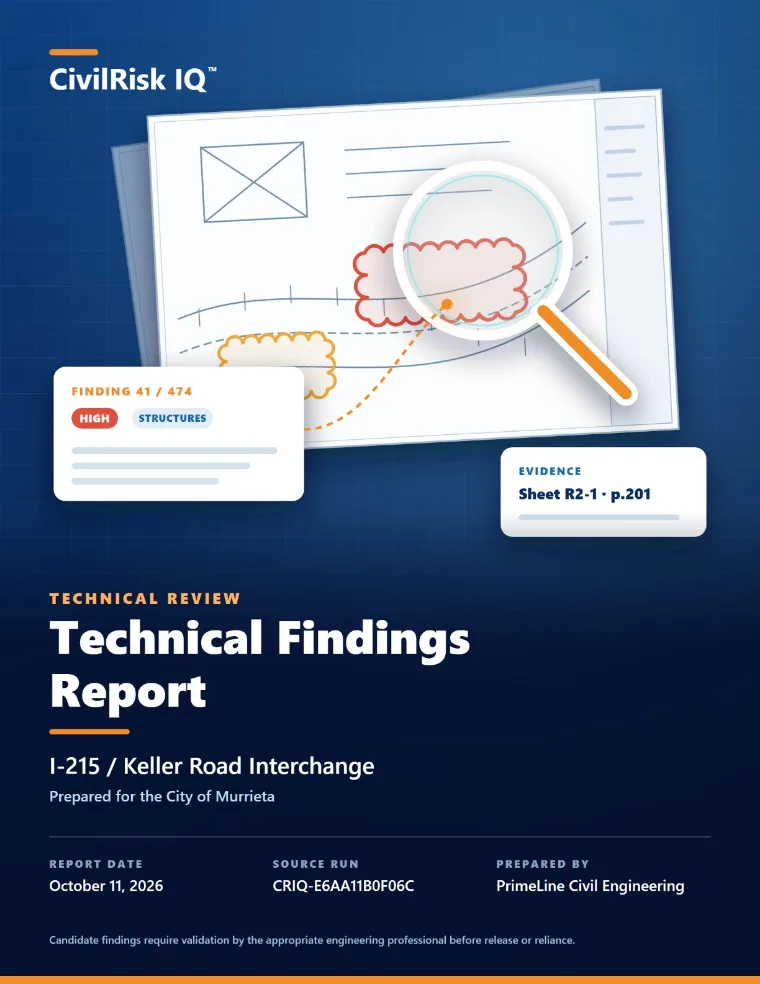
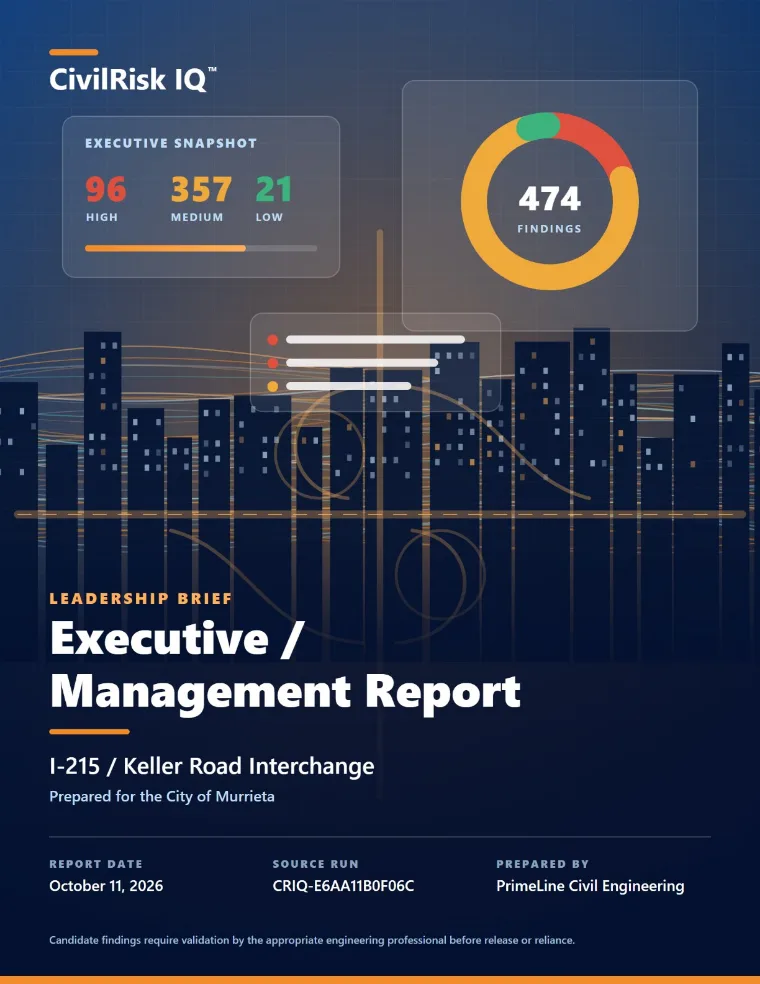
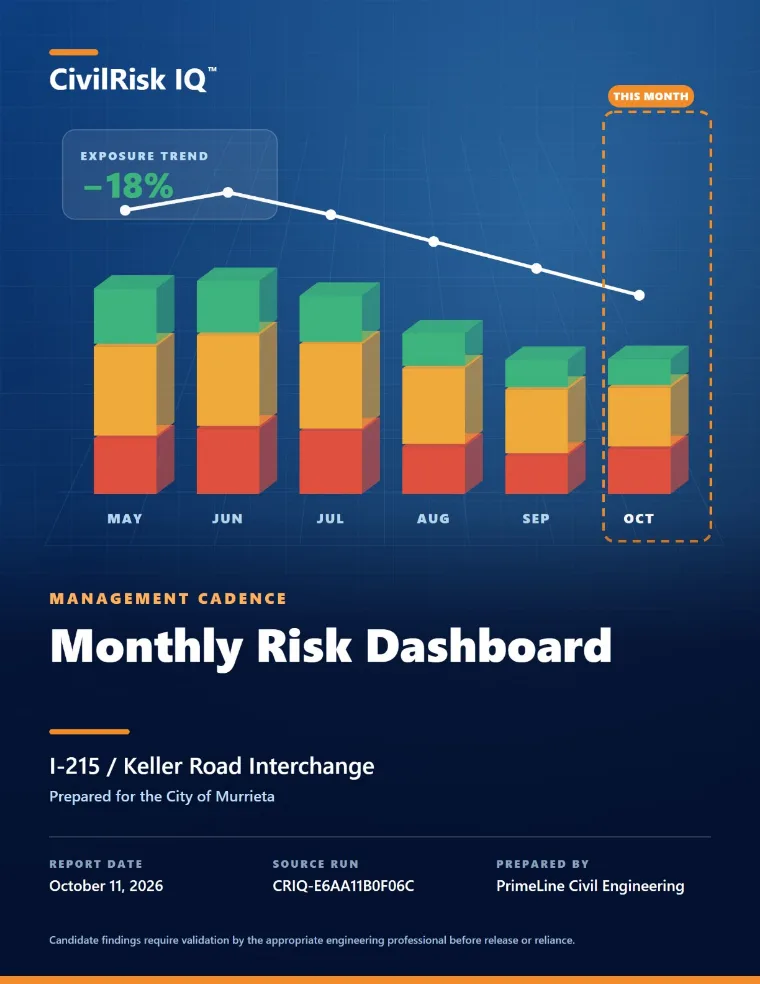
Consultant plans & PS&E
Any milestone from 30% to 100%, on or off the State Highway System: roadway, drainage, structures, traffic, utilities and staging.
For public agencies · planning through construction
CivilRisk IQ reviews consultant plans, technical reports, CEQA/NEPA documents and local capital projects for public agencies. 21 AI specialists prepare sheet-referenced findings; your engineer or authorized decision-maker decides. Put taxpayer resources to work wisely.
Caltrans districts, cities, counties and transportation commissions · Typical review in 5–10 business days
What we review for agencies
State highway projects or local capital improvements: when a consultant hands your agency a package, CivilRisk IQ can review it before you accept it.
Any milestone from 30% to 100%, on or off the State Highway System: roadway, drainage, structures, traffic, utilities and staging.
EIRs, EISs, EAs and IS/MNDs and every study inside them, screen-checked before circulation. Your decision-maker decides.
Geotechnical, soils and materials, foundation, structures, hydrology and drainage, traffic and utility reports behind the plans.
PSRs, project reports, PA&ED and PS&E packages, design standard decision documents and storm water data reports.
Pavement rehabilitation, curb and gutter, sidewalks and ADA ramps, storm drains and signals for cities and counties.
Special provisions, quantities, engineer's estimates and construction schedules, checked against the plans before you advertise.
Don't see your document?
A real finding, step by step
How to read our examples: these are real candidates from CRIQ reviews of actual plan sets. Each shows its status; a candidate is a question for the design engineer, not a verified defect or a statement about current field conditions.
FL 1568.55 ft
Bioswale 45 beginningFL 1566.96 ft
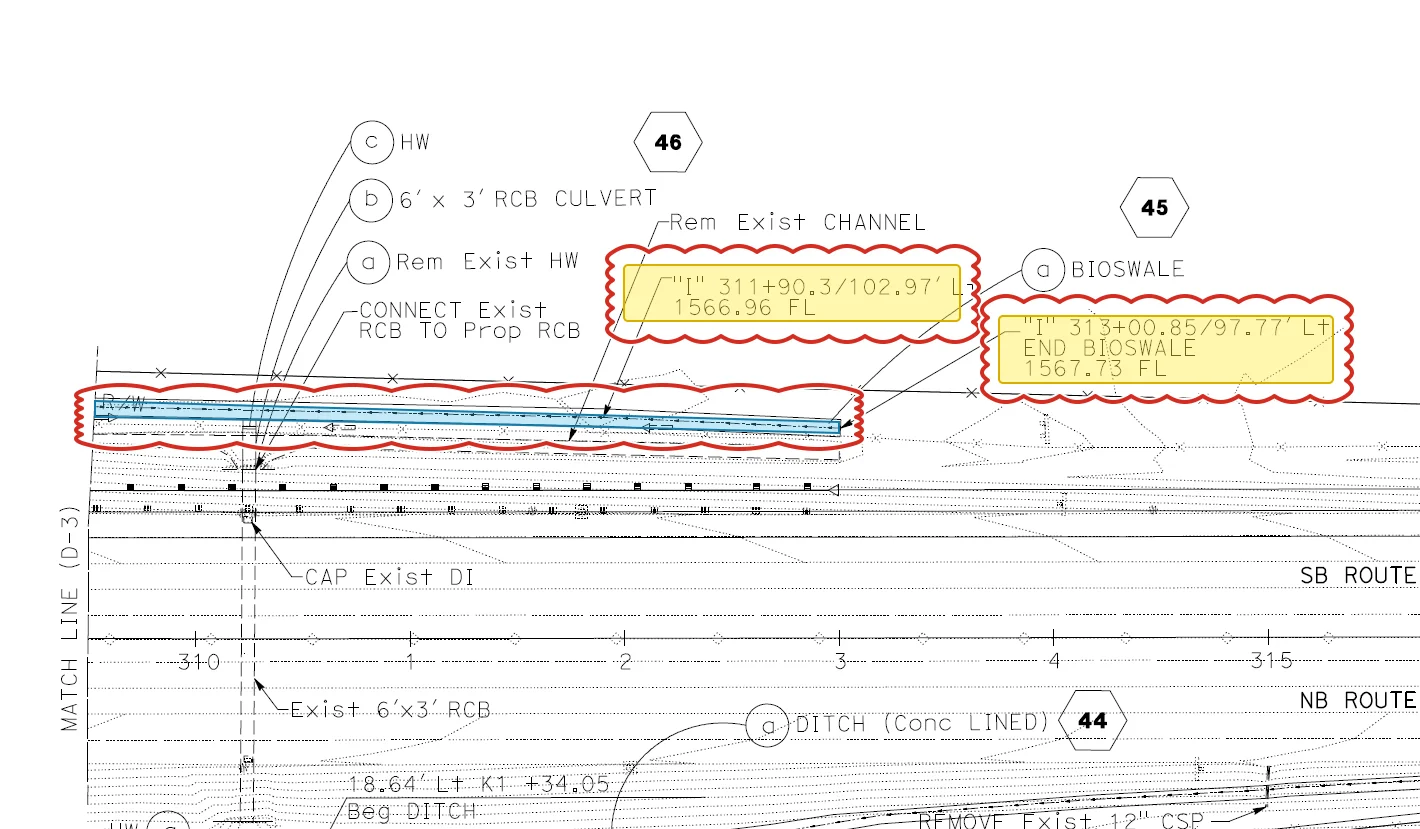
Intermediate gradeFL 1567.73 ft
End gradeI 311+90.3: FL 1566.96
I 313+00.85: FL 1567.73
End elevation is 0.77 ft above the intermediate low point.
No collection point was identified in the compared sheets. A rising grade alone does not establish a drainage defect.
Source-plan and drainage-design check neededConfirm stationing, flow-line elevations and the plotted grade on the source sheets and adjacent drainage details.
Is there an inlet, underdrain, cross-sheet connection or intentional reverse flow?
Engineer decides whether the concern holds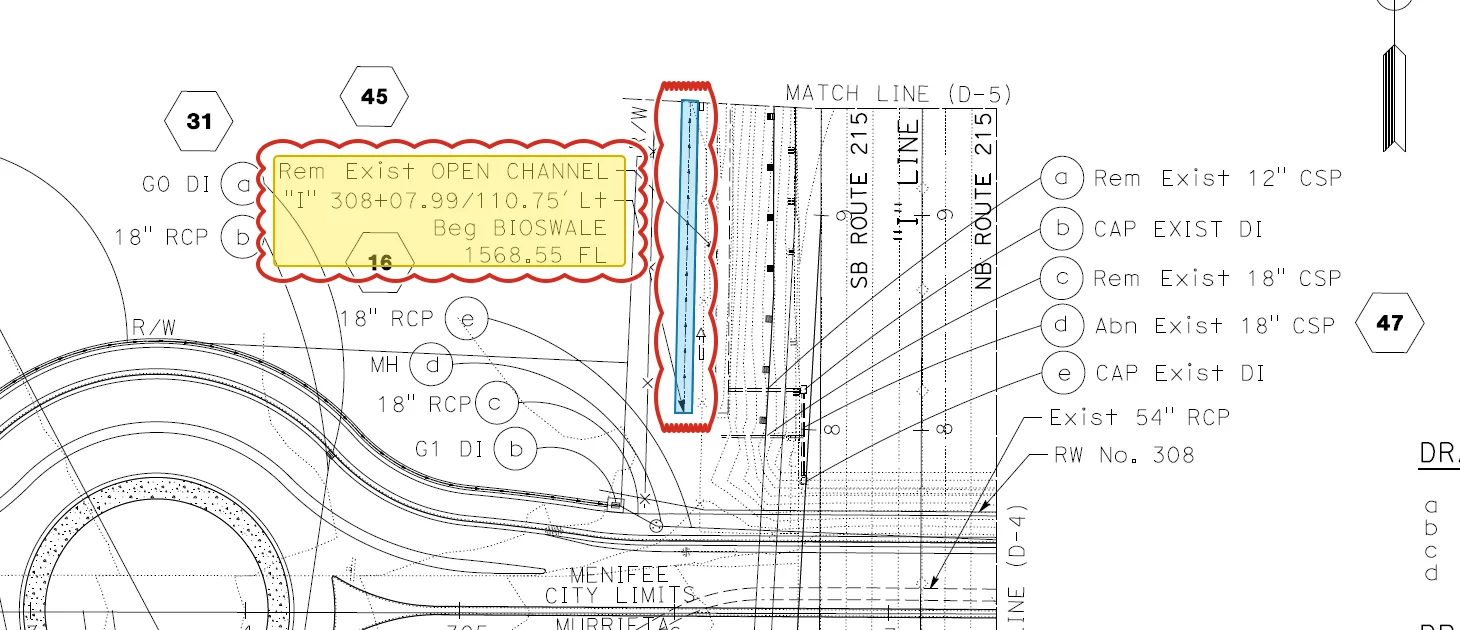
From the engineering desk to the council agenda
Tap a cover to see it full size. Formats are agreed during scoping.
Getting started
Use the complimentary 20-minute call to discuss the project, your questions and whether a scoped review fits.
Agree on the records, deliverables and date, then set it up by purchase order or on-call task order.
Upload through a project-scoped portal with authorized access; we help your IT and procurement teams with security documentation.
Receive the findings in 5–10 business days, discuss open questions and set the follow-up with your consultant.
Questions agencies ask
No. CivilRisk IQ gives your reviewers a sheet-referenced head start on every submittal. Your staff keep their judgment and authority; the specialists make sure nothing in a large package goes unread.
Yes. That is the most common agency use: plans at any milestone, design technical reports, environmental documents and Caltrans deliverables, reviewed before your agency accepts or approves them.
Yes. Nine environmental specialists screen EIRs, EISs, EAs and IS/MNDs and every technical study inside them before circulation. Environmental findings are decided by your authorized decision-maker, not by CivilRisk IQ.
Yes. City and county capital improvement projects such as pavement rehabilitation, curb and gutter, sidewalks and ADA ramps, storm drains and signals use the same specialist team and method.
A typical review takes 5 to 10 business days, depending on the size of the package and the agreed scope.
Files are stored per project with authorized access only, and raw agency documents never train models silently. We help your IT and procurement teams with the security documentation they need before records are shared. Security & data.
Start with a complimentary 20-minute consultation. From there we scope a review around your next submittal or decision. Agencies typically engage CivilRisk IQ through a purchase order or an on-call task order.
A conversation with the founder
Complimentary 20-minute consultation with founder Jason Bennecke. No project files needed. Meet Jason →
Authorized access, project-scoped storage, and no silent training on your documents. Security & data →