Before any files
A consultation and a written scope: documents, review questions, deliverables, date, responsibilities and confidentiality terms.
How it works
Exactly what happens in a CivilRisk IQ review: what we need from you, how 21 AI specialists and an accountable human reviewer work through the record, and what you receive in 5–10 business days.
No files needed to start · Written scope before any upload · Typical review in 5–10 business days
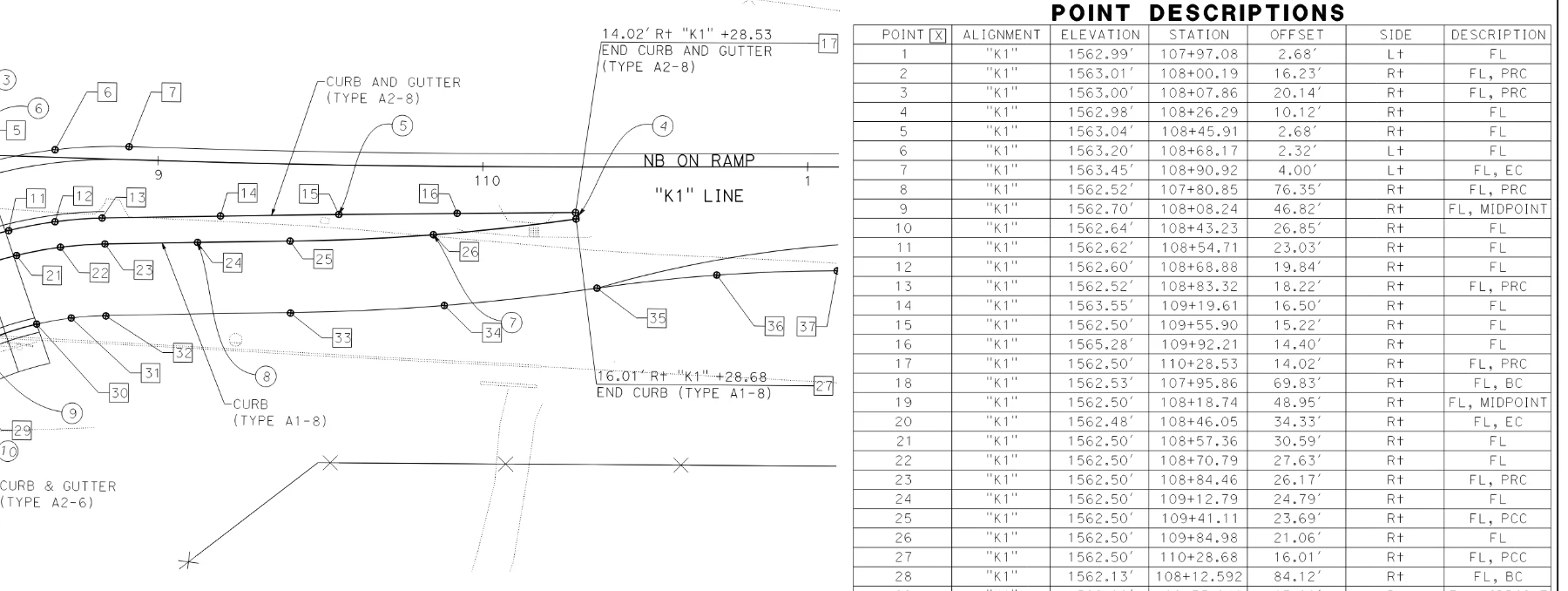
Observation. The point table puts the flow line at 1562.52, 1563.55, 1562.50, 1565.28 and 1562.50 ft for points 13–17. Point 16 is 2.78 ft above points 15 and 17, each about 36 ft away: roughly a 7.7% climb, then a 7.7% drop.
Why it matters. As tabulated, the curb can’t follow a smooth profile. A crew staking from this table would build a hump; if the elevations are intended, drainage and vehicle clearance need a second look.
Next check. Recalculate the curb profile from the grading model, compare points 14–17 with the K1 profile and the adjacent curb, and confirm none of the elevations belong to a different edge.
The review, step by step
Every engagement is bounded by its project record, review questions and delivery date, so you always know what happens next.
A complimentary 20-minute call with Jason. Share the project and the decision ahead; no files needed.
Agree on the documents, review questions, deliverables and date. Scope, responsibilities and confidentiality are confirmed in writing before any project material changes hands.
Authorized contacts upload the agreed source package to a project-scoped workspace. Only material the review needs.
12 plan-set and 9 environmental specialists read every sheet and page in parallel. A manager pass merges duplicates and assigns likely severity; a Red Team challenges weak claims. Scanned pages are read with OCR.
A licensed engineer (design) or an authorized decision-maker (environmental) checks the evidence and decides what is released. What is still unknown stays visible.
Reports, a findings register and PDF comment files, plus a walkthrough with your team. Your reviewers confirm, revise or dismiss each finding in the portal.
What we need from you
We begin with only the material the agreed review needs. A typical source package includes:
Independent by design
CivilRisk IQ is built by PrimeLine Civil Engineering, a project management firm that oversees design work and does not design projects.
Every finding points to its sheet, page and source text, so anyone can check it and the design team can answer it.
A candidate is a question, not a verified defect. The review separates what the record supports from what is still open.
Engagement requirements
Three checkpoints keep every engagement clear and defensible.
A consultation and a written scope: documents, review questions, deliverables, date, responsibilities and confidentiality terms.
Authorized contacts confirmed and the agreed source package uploaded to a project-scoped workspace.
A debrief, reviewer decisions recorded in the portal, and guest access removed within 5 business days of project close.
No public pricing. Each engagement is scoped to the project, the source record and the decisions ahead. Agencies typically engage through a purchase order or an on-call task order.
What you receive
Formats are agreed during scoping. Tap a cover to see it full size.
Questions about the process
A typical review takes 5 to 10 business days from receipt of the agreed source package, depending on its size and the scope. Tell us your submittal or decision date and we will plan around it.
The documents in scope, usually as PDFs: the plan set at the milestone being reviewed, the technical reports and studies behind it, and any specifications, estimates, schedules or environmental documents included in the scope. Scanned pages are fine; they are read with OCR.
Yes. The first conversation needs no project files, and no project material changes hands until the scope, responsibilities and confidentiality terms are agreed in writing.
There is no public price list. Each review is scoped and priced to the package, the review questions and the deliverables. Agencies typically engage CivilRisk IQ through a purchase order or an on-call task order.
A candidate is an issue raised by one of the AI specialists. A manager pass merges duplicates and a Red Team challenges weak claims, so far fewer candidates survive: on the I-215 / Keller 95% PS&E plans, 1,212 candidates became 474 retained findings. A person with authority over the work then decides what is released.
A licensed engineer for plans and technical reports, or an authorized decision-maker for environmental documents. AI specialists find and organize the issues; people make the call.
CivilRisk IQ is built by PrimeLine Civil Engineering, a project management firm that oversees design work and does not design projects, so the review has no stake in the design. Every finding is tied to its sheet and page, and what remains uncertain is kept visible.
Start with the decision
Complimentary 20-minute consultation with founder Jason Bennecke. No project files needed. Meet Jason →
Authorized access, project-scoped storage, and no silent training on your documents. Security & data →